
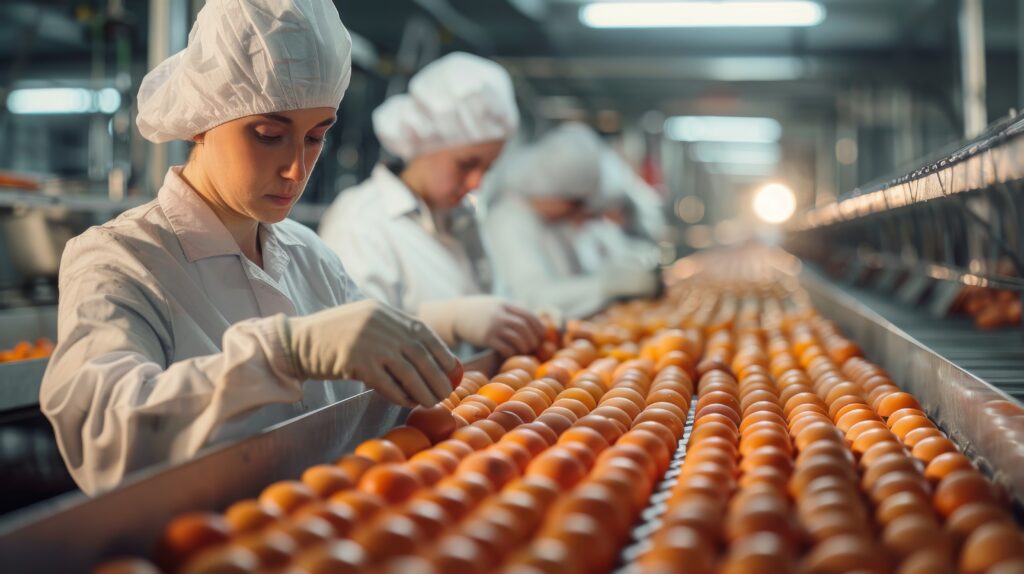
I feel like a lot of food manufacturing business owners ask themselves some version of this question: how do I automate my production and packing process so my business can actually scale and break free from labor-related inefficiencies?
Maybe that’s not exactly how you’d phrase it, but the reality is this: every business owner is looking for ways to get out of the rat race. You want to make a great product, in an efficient way, that actually lets you grow and become financially free.
And I get it—it can feel hard to believe it’s possible, especially if you’re just starting out or if you’ve been grinding away for years but stuck in the same place. But it is possible.
Common Barriers Business Owners Face
Here are some of the most common reasons food packaging business owners hesitate to automate:
- They don’t know what kind of equipment even exists.
- If they do know, there’s too much info out there—it’s overwhelming and hard to connect the dots. (After all, you’re an expert on your business, not on automation.)
- They’re afraid automation will be too expensive to pay off.
- They feel like they should first get their processes and SOPs in order.
- They fear their team won’t adapt well to new machines.
- They think they need to start way bigger than they actually do.
These are real and valid fears. But the truth is, they can all be overcome with the right guidance and a clear blueprint.
Why Automation Matters (Now More Than Ever)
Before we talk about how to automate, you need to understand why. Why does it matter for you right now?
The Common Pains
- The people factor: Nothing against people (we all love at least some humans, haha), but relying on them for endless, low-value repetitive tasks? Painful. Opening bags, filling cups, sealing packages thousands of times a day, by hand? Yuck. And mistakes are inevitable.
- Labor cost: People are not only unpredictable, they’re expensive—and historically more expensive by the day.
- Limited capacity: How would you quadruple your production if you suddenly landed that big client? Quadruple the workforce? That’s 4x the cost and 4x the problems.
- Slow: Unless you’ve got a Michael Phelps or Usain Bolt of packaging on your team, manual labor will frustrate you with its slowness. And even if you do, they can quit, get sick, slow down, or get injured.
- Recall risks: Human errors—like a poorly sealed package or the wrong fill weight—can turn into your worst nightmare: recalls.
- Contamination: A type of recall, but more serious. It can damage your brand beyond repair.
- Lack of visibility: Manual production = chaotic reporting. Often you have no data, or worse, wrong data. And who has time to fill out accurate logs in the middle of production mayhem anyway?
The Benefits of Automation
- Reliable: Machines don’t call in sick. They last for years if maintained.
- Stress-free: Drastically reduce the human factor in repetitive tasks.
- Scalable capacity: Machines let you 4x, 5x, even 10x output with a fraction of the labor cost.
- Speed & productivity: Faster than humans—by a lot.
- Consistency: Precision in weight, volume, sealing, and presentation.
- Safety: Protects your people from repetitive strain injuries and integrates modern safety systems (sensors, e-stops, etc.).
- Cleanliness: Minimizes contamination risk.
- Tracking: Machines provide real-time data and monitoring with user-friendly HMIs and cloud connectivity.
How to Know What Level of Automation You Need
I’m a pretty utilitarian guy. Which means the most valuable thing to me is the thing that is most practically useful to me RIGHT NOW. That’s why I don’t recommend the sexiest, most expensive piece of equipment if you don’t actually NEED it.
So let’s break this down:
- Take the number of units you produce/sell per month.
- Divide by 22 (average working days in a month).
- Divide by 8 (hours per shift).
- Divide by 60 (minutes per hour).
👉 The result = your per-minute rate.
Then ask:
- How many people are doing this production?
- Are they doing it fully manually, or with some semi-automated tools?
Now you’ve got a clear picture of your “automation stage.”
- Under 50k units/month: You probably just need semi-automated solutions (tabletop filler, auger, pump, or counter).
- 100k–150k units/month: By now you likely already use some semi-automation. Adding a small 10–15 bags/min bagger can take you to the next level by either 2X-ing or 3X-ing your current production, or just by cutting a lot of the labor-related costs.
- 200k–300k+ units/month: If you’re still manual-heavy here, you’re burning money. A 30–45 bags/min bagging machine (premade or form-fill-seal) is almost always the smarter move.
I’d also like to make a point here for SOP’s and process optimization. Really, there’s also a big likelihood the tools you already have in place could be enough if your processes, systems and personnel were better implemented or better trained. I invite you to consider how you can improve your current process with what you have, even before thinking of automation. I might sound counter intuitive, but that exercise will help you in the short term, but it will also emphasize the actual need for automation in the long run. Because when your team is working at 100% capacity and possible efficiency and they’re still cramming through orders, that’s when you know you need a different solution.
Remember: the goal isn’t to buy a machine. The goal is to scale your business—to sell more, at better margins, with fewer problems—so you can buy back your time as an owner.
Case Studies
Here are some examples and case studies that will help you understand these principles a little better and bring some more clarity as to where you are at on the automation path.
Case Study 1 – The Fully Manual Producer
Ana runs a small family business making artisanal snacks. She and her team of five employees hand-fill and seal about 30,000 units per month. At first, it worked fine, but as orders increased, they realized they were spending most of their time on repetitive, manual tasks. Labor costs kept going up, mistakes were common, and Ana had no visibility into daily production numbers. Once she invested in a semi-automatic filler and tabletop sealer, she reduced her labor needs by half, cut mistakes almost completely, and freed her staff to focus on product quality and sales.
Lesson: If you’re under ~50k units/month, even a small semi-automatic setup can drastically reduce stress and inefficiencies.
Case Study 2 – The Semi-Automated Growth Stage
Carlos operates a mid-size sauces company producing about 120,000 units per month. He already had a tabletop filler, but employees were still hand-loading bags and sealing them. The line was bottlenecked, and he couldn’t keep up when a large supermarket placed a recurring order. Carlos invested in a compact 15 bags/min bagging machine that worked in tandem with his filler. His staff only had to replenish packaging materials and keep the product fed. Within three months, he increased his throughput by 25% and cut his payroll costs in almost half.
Lesson: At the 100k–150k unit/month stage, adding a small bagger under your filler creates exponential gains without massive capital investment.
Case Study 3 – The Scaling Producer
Maria’s protein powder brand grew quickly, hitting 300,000+ units per month. She had a mix of small fillers and six people running the line, but payroll costs were crushing her margins. Worse, inconsistencies in fill weight and sealing caused costly waste. Maria decided to invest in a 45 bags/min form-fill-seal machine with integrated dosing and reporting. The upgrade not only allowed her to scale production to meet larger contracts, but also gave her real-time data on yield, rejects, and efficiency. Her labor costs went down, recalls became a non-issue, and she finally had confidence to pitch larger retail chains.
Lesson: Once you’re over ~200-300k units/month, a robust bagger or FFS system is usually cheaper (and safer) than paying a growing manual crew.
Conclusion
Hopefully these examples give you some clarity, which frankly is the most important thing when it comes to making a business decision. I hope you understand that your brand is an amazing thing you’ve put so much care into creating — and that both it and your consumers deserve the best quality, at the best cost, and at the best time possible.
At the end of the day, automation isn’t just about machines, it’s about giving your business the freedom to grow without limits. If you’re ready to explore what the right level of automation looks like for you, let us help. Get in touch with our team today and let’s design the next stage of your packaging line together.